← Essays · November 18, 2026 · 16 min read
Life Story Book for Elderly Parents: How to Make One
How to make a life story book for an elderly parent or grandparent: what to include, which questions to ask, and how to adapt it for memory care.
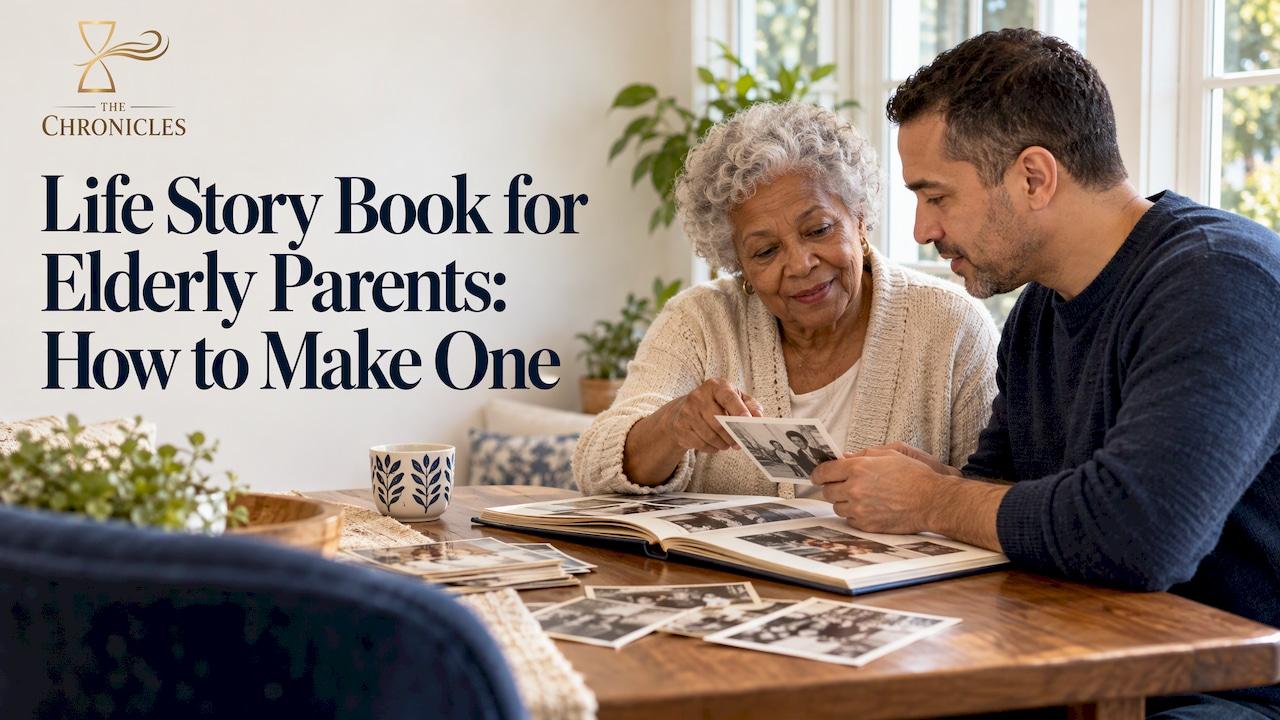
Life Story Book for Elderly Parents: How to Make One
A life story book for an elderly loved one is a book of their own life, told in their own words and photographs: where they grew up, who they loved, what they worked at, what they would want the grandchildren to know. The best way to make one is slowly, one small memory at a time, with the person at the center and the family helping. We built The Chronicles for exactly this: you add a photo and a few words, and each memory becomes a written chapter you can hear aloud and, when you are ready, print.
This guide walks you through it: what belongs in the book, the questions that unlock real stories, how to do it when your mom or dad lives in a nursing home or memory unit, and how to keep it gentle when memories are tender.
TL;DR
- A life story book is a keepsake and a conversation tool. Start with one photo and one question, not a blank page.
- Specific questions get better stories than broad ones. Ask about one friend, one kitchen, one object.
- For a parent with dementia, go one topic at a time, keep it positive, and let sessions stop and start.
- Relatives who dislike technology can contribute through guided email interviews, with no login.
- The Chronicles turns photos and short memories into chapters, with narration and print books from $49.
Table of Contents
- What a life story book is, and what it is not
- Decide the purpose before you start
- What to put in the book
- Questions that get real stories
- Gathering stories and photos from the whole family
- Making a life story book when a parent is in a nursing home or memory unit
- Simple ways when time, energy or writing ability is short
- Handling sensitive memories with care
- When the book becomes a memorial
- Making it with The Chronicles
- FAQ
- Sources
What a life story book is, and what it is not
A photo album shows what a life looked like. A life story book explains it. Each page pairs a picture with the story behind it: who is in the frame, what was happening, why it mattered. Put simply, it is a photo album that talks.
It also differs from a general "comfort book" of uplifting readings. Those are written by strangers for any reader. A life story book is about one person, and its power comes from being specific to them: the nickname only the siblings used, the street where the family first rented, the recipe that was never written down.
For older adults the book does several jobs at once. It preserves stories for grandchildren who will want them later. It gives the person a reason to reminisce with someone who is listening. And for families facing memory loss, it becomes a practical tool: a review of life story resources in dementia care describes four purposes of life story work: supporting identity and coping, helping conversation, building connections between the person, relatives and staff, and informing everyday care.
Decide the purpose before you start
AARP's guide for families suggests agreeing first on why you are making the book: preserving stories for grandchildren, offering a creative outlet, helping your loved one relive happy memories, or strengthening family relationships. It also advises focusing on what the person most wants to talk about, whether that is childhood, one era, a theme or a passion.
That last point matters more than it sounds. Nobody has to cover eighty-five years. A book about the farm years, or the years at the shipyard, or the summers at the lake, is a real life story book and far more likely to get finished.
A quick way to decide:
- For grandchildren: a chronological book from childhood forward, with plenty of family names.
- For comfort in care: shorter, happier, built around familiar faces and places.
- For a milestone birthday or anniversary: a favorite era or a love story. Our anniversary memory book page shows how years of shared chapters become a gift.
- For remembrance: a memorial book, covered below.
What to put in the book
A home-care provider's guide lists the building blocks most families include: full name and nicknames, birthdate and birthplace, a family tree overview, childhood memories and first jobs, marriages and partnerships, military service and career highlights, favorite recipes and traditions, values and advice, captioned photographs, documents, and meaningful quotes or poems.
Treat that as a menu, not a checklist. A practical order that works well:
- Where it began: birthplace, parents, siblings, the house, the neighborhood.
- Growing up: school, friends, chores, first jobs, the songs on the radio.
- Love and family: how they met, the wedding, becoming a parent.
- Work and calling: the jobs, the proud days, the hard bosses, military service if there was any.
- Traditions: holiday meals, recipes, sayings, the way Sunday always went.
- What they have learned: the advice they would pass on.
Label every photo with names, place and rough year. Those labels are the part nobody else will be able to supply in twenty years.
Questions that get real stories
The common mistake is asking something huge. "Tell me about your teenage years" invites a shrug. AARP's advice is to ask something specific, such as who your mother's best friends were at 16 and what they loved doing together.
Sensory questions work especially well. An aging-services blog explains that smell and sound memories are anchored near the brain's emotional center, and suggests prompts such as describing the kitchen of the home you lived in at ten, writing about one object you have owned for thirty years or more, or a letter to an unsung mentor.
A few to start with:
- What did the kitchen in your childhood home smell like on a Saturday morning?
- Who was your best friend at 16, and what did you two get into?
- What is the one object you have owned the longest, and where did it come from?
- Who taught you something you still use? What did they say?
- If you could write a letter to yourself at 20, what would it say?
One question at a time, and then let them talk. The follow-up ("What happened next?") often yields more than the first answer. For a deeper walk-through of interviewing technique, see our guide to conducting an oral history interview with your family.
Gathering stories and photos from the whole family
You do not have to be the only author. AARP recommends interviews in person, or by phone or computer when you cannot be there, recorded on a phone or laptop. Brothers, sisters, cousins and friends can add their own anecdotes, and photographs can be grouped by category, with old images restored where needed.
This is where many family projects stall. One person is writing, three relatives have boxes of photos, and Uncle Ray will never sign up for an app. In The Chronicles, relatives who are less comfortable with technology can contribute through guided email interviews: they answer by replying to an email, with no login. Everything lands in the same family chronicle, so the book keeps growing as more people remember.
We go deeper on the collaborative approach in how to make a grandparents life story book together and how to create a parents life story book together. If you are collecting stories by voice, our guide to recording a grandparent's life story covers the recording side.
Turning photos into chapters
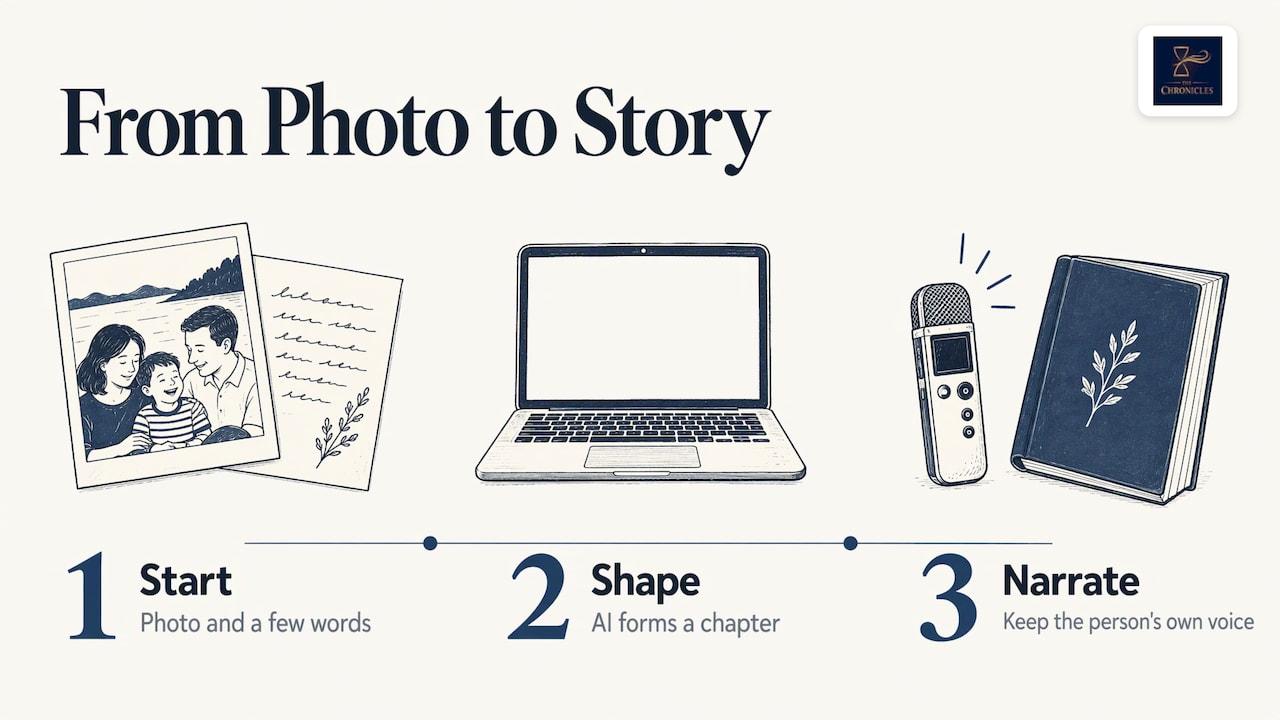
The slow part of any life story book is writing. A photo from 1962 and two sentences of memory are enough to start: our AI memoir writer turns photos and short memories into written chapters you can edit and make your own. If you love scrapbooking, our piece on the digital family scrapbook shows how photos become stories rather than captions.
Making a life story book when a parent is in a nursing home or memory unit
If your mom or dad is in a care community, the book can be even more valuable, and it can be done in short, calm visits.
In a controlled trial of people with mild to moderate dementia, life story books made through life review sessions or as a gift from a relative both improved the quality of the relationship between relatives and the person, and staff knowledge and attitudes. Those books averaged 50 to 70 pages, were chronological with clearly labeled pages, and were printed in three copies: one for the resident, one for a relative and one for care-home staff. That last detail is worth borrowing. A copy kept in the room gives aides and nurses something to talk about besides the weather.
Gentle ground rules
Dementia UK offers practical guidance you can follow at any visit. Involve the person as fully as you can, take one topic at a time, prompt with photos of familiar people and places, and use open conversation starters such as asking where they grew up, rather than firing off questions. It also suggests keeping the story "live" so it can be updated, and choosing a format suited to the person: simple books with high contrast and clear fonts, collages for later stages, or memory boxes when sight or hearing is limited.
A few more points from care guidance worth remembering:
- Accuracy is not the goal. A Canadian health-authority guide advises capturing the story as the person recalls it, because exactly who did what and when is not important.
- Use older photos. The same guide notes that photos from an earlier time can help a person recognize family members who, in their memory, live at an earlier time. A picture of your father at 30 may land better than one of him last year.
- Check the photos first. Alzheimer Ireland advises confirming photo details with a family member before a session, since some people become agitated when they cannot recognize faces or names.
- Let it stop and start. A 2026 US study of at-home life story work notes that sessions can be halted and resumed as conditions dictate. In the trial above, some sessions were shortened to 30 minutes when engagement was hard.
The book as comfort
The making is itself a meaningful activity, and the finished book is a tool for hard moments. Alzheimer Ireland notes that sitting with an agitated person and looking through the finished book with familiar photographs can reduce distress.
This is where hearing the story helps. With The Chronicles, chapters can be narrated aloud, including in a real voice, or with consented voice cloning. For a parent whose eyes tire or who no longer reads easily, a familiar voice reading the family's chapters can be easier than a printed page. Our voice memory book page explains how chapters are heard aloud.
Simple ways when time, energy or writing ability is short
Most families do not have weekends to give. The same 2026 study lists low-effort formats: a weekly "story page" of one photo and a few sentences, story boxes with objects and index cards, fillable templates, binders or digital albums, and audio recordings.
The weekly story page is the one we would pick, and it matches how The Chronicles works:
- Choose one photo from a box or phone.
- Ask one question about it, in person, by phone or through a guided email.
- Add the answer as a few sentences or a voice recording.
- Let the chapter take shape, then read it back to your parent and fix anything that does not sound like them.
Ten minutes a week gives you about fifty chapters in a year, which is a real book. The Chronicles has no ads and no lock-in, so you can pause during a hard month and pick up again.
Handling sensitive memories with care
Every long life holds losses, estrangements and things never discussed. The kindest rule is that the book belongs to the person it is about.
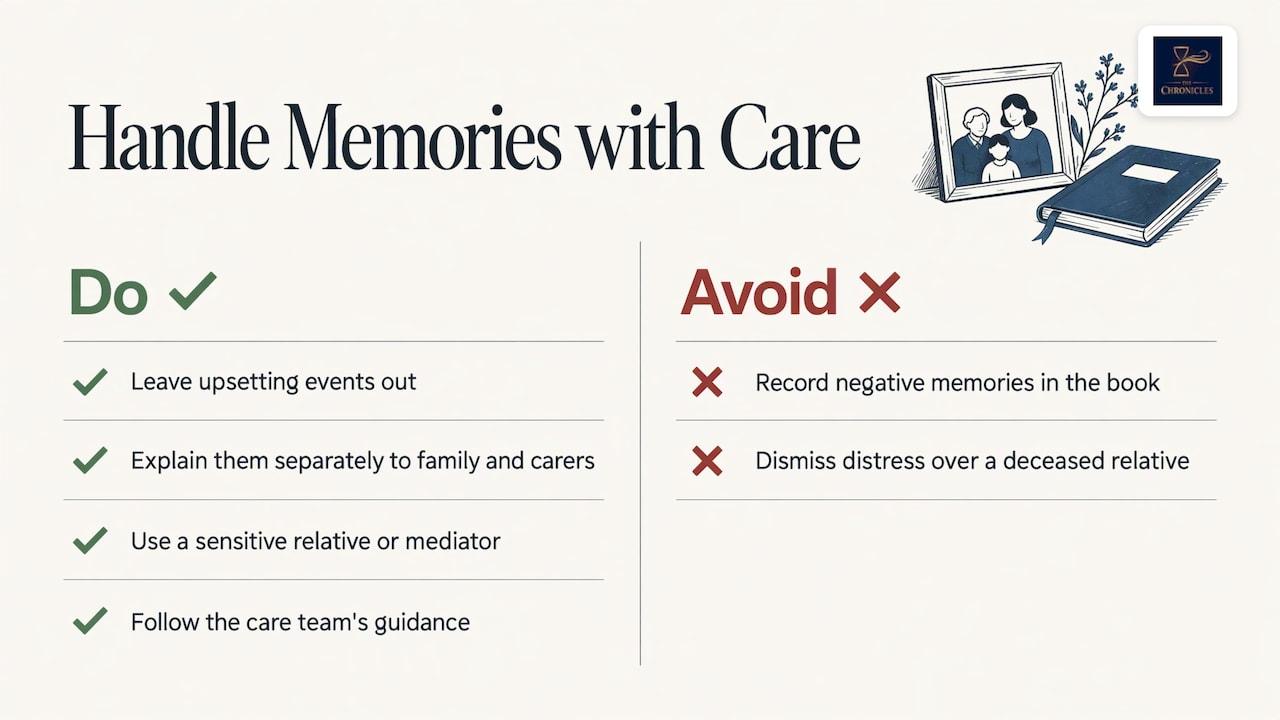
Dementia UK advises being sensitive about what they would want shared, and says that sad or traumatic events that may cause worry or upset can be left out of the story and explained in a separate document for family, friends and carers. Alzheimer Ireland adds that memories with negative connotations for the person should not be recorded in the book, and that if a photo of a deceased relative causes distress, you acknowledge the feelings gently.
When siblings disagree about what to include, a multimedia biography study recommends that a mature, sensitive family member or an outside mediator facilitate the discussion. The same researchers found that families were eager to search for materials and enjoyed the process, but that a personal, human approach must be kept even as software becomes more automated.
If your parent has memory loss, make the choices with a physician, social worker or the care team's guidance in mind, and share the finished book with those caring for them. Privacy matters here too. Your parent's stories are personal, and The Chronicles pledges never to use family stories to train AI, and you keep full ownership with easy export.
When the book becomes a memorial
Sometimes the project starts after a loss. A life story book built from a parent's photos and the family's memories becomes a place where their voice and humor stay. You can collect stories from every sibling and friend, in any order, and there is no wrong way to begin. Our memorial memory book page describes how one chronicle holds those memories together.
If you are preparing for a service, the stories you gather can also feed what is said aloud. A celebration of life ceremony script can help you shape a gathering around them, and the chapters can be read at the service or printed for guests.
Our view: the story is the gift
We started The Chronicles because family stories vanish quietly. Nobody decides to lose them. A phone call gets shorter, a box of photos goes unlabeled, and one day nobody left can say who is standing next to Grandpa in the picture.
What we have learned is that people rarely fail at life story books because they lack time or talent. They stall at the blank page. That is why we begin with a photo and a few words, let AI shape them into a chapter, and keep the person's own voice, literally, in narration. Relatives who avoid technology can still take part through guided email interviews, so the book belongs to the whole family.
We also believe the stories should stay in the family. We never use them to train AI, you own what you write, and you can export it whenever you like. A life story is the most personal thing a family has. It should be treated that way.
Kevin
Making it with The Chronicles
You can start with the Free plan at $0 and see how a photo becomes a chapter. The Chronicle plan is $7 per month, and the Family plan is $15 per month, so several relatives can build the same story. When you want something to hold, a Paperback starts from $49 and a Hardback from $99, as published on our site.
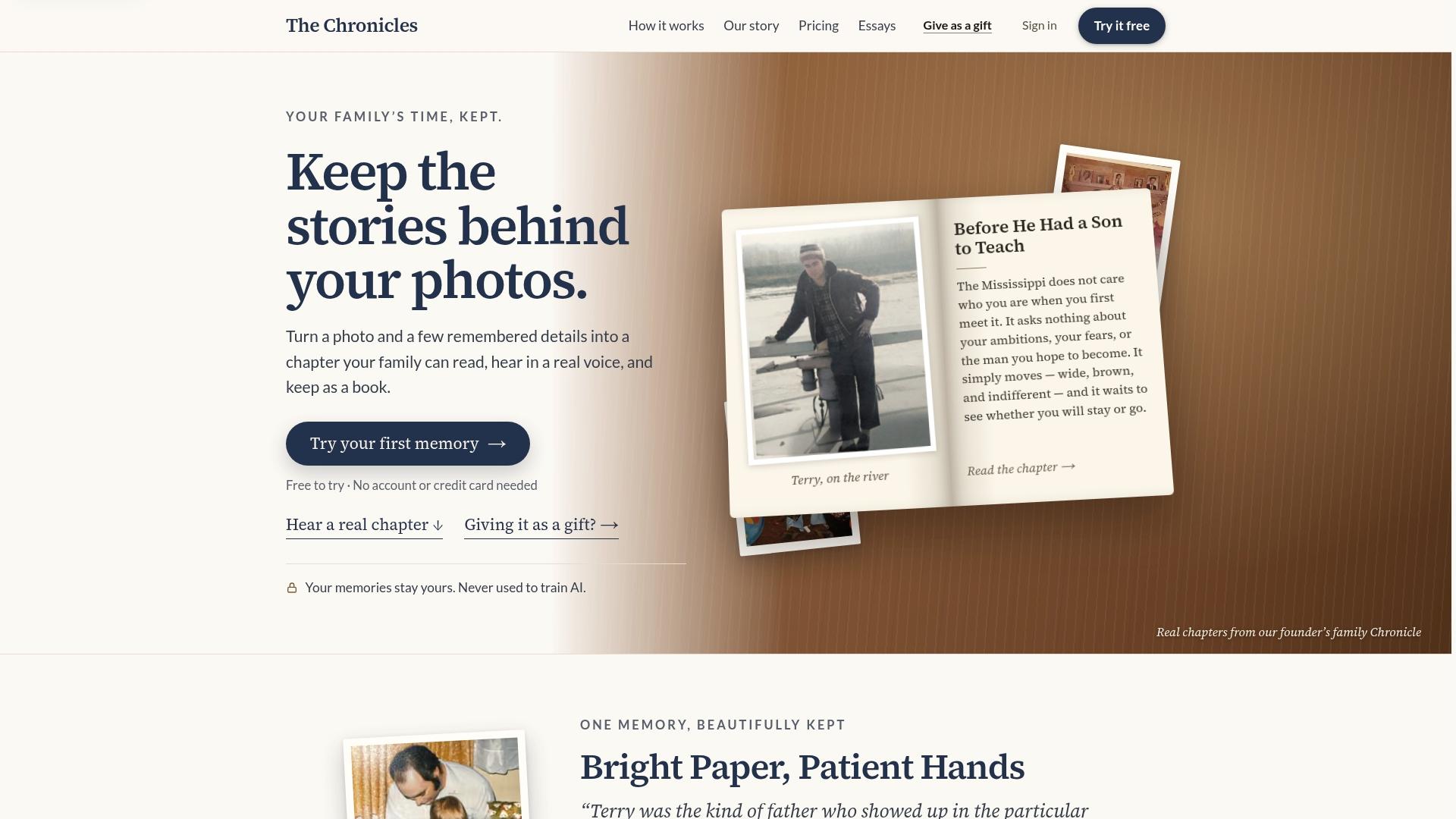
Pick one photo of your parent or grandparent tonight, and start your first chapter on The Chronicles. When you are ready for the printed keepsake, see the paperback and hardback books.
FAQ
How long should a life story book for a senior be?
There is no right length. In a dementia care trial, the books averaged 50 to 70 pages, but a shorter book on one favorite era is just as real. Aim for what your loved one can enjoy and finish, then add chapters later.
What if my parent cannot remember details or gets confused?
Capture the story as they tell it. Care guidance says accuracy of who did what and when is not important, and that familiar photos are the best prompts. Keep sessions short, stay with happy memories, and stop whenever they tire.
What if my parent does not use a computer or email?
They do not have to. Sit with them and ask the questions yourself, in person or by phone, and add their answers to the book for them. Other relatives who find technology hard can answer guided email interviews with no login.
Who should make the book, the parent or the children?
Both is ideal. Research in dementia care found that books made together in sessions and books given as a gift by a relative both improved relationships. If your parent can take part, involve them as fully as possible. If not, build the book from photos, family memories and what you know they loved.
Can a life story book be printed?
Yes. On The Chronicles you can order a printed book once your chapters are ready: a Paperback from $49 or a Hardback from $99. The digital chronicle continues, so you can add chapters and print again.
Sources
- How to Help Older Loved Ones Write Their Life Story, AARP
- 5 Creative Writing Prompts for Senior Life Storytelling, Aging at Ease
- Creating a Life Story Book: A Meaningful Legacy Project, RD Wilson Home Care
- Life review and life story books for people with mild to moderate dementia, PMC
- Life story resources in dementia care: a review, PMC
- Creating a life story for a person with dementia, Dementia UK
- A Guide to Creating a Life Story for Care-giving, Interior Health
- Life Story Book at home, Alzheimer Ireland
- Life Story Work with a Person Living with Dementia, Kennesaw State University
- Multimedia Biographies, Ron Baecker
Recommended
From the founder
Start your first chapter — three minutes, no account.
Drop in a photograph of someone you love. Write three sentences about a moment with them. The Chronicles writes the chapter.
Try it free →Questions or thoughts? kevin@thechronicles.life — I read everything.