← Essays · November 1, 2026 · 15 min read
Questions to Ask Your Grandparents: 80+ That Spark Real Stories
Over 80 questions to ask your grandparents, grouped by life stage, plus tips for a relaxed interview and ways to keep their answers for the family.
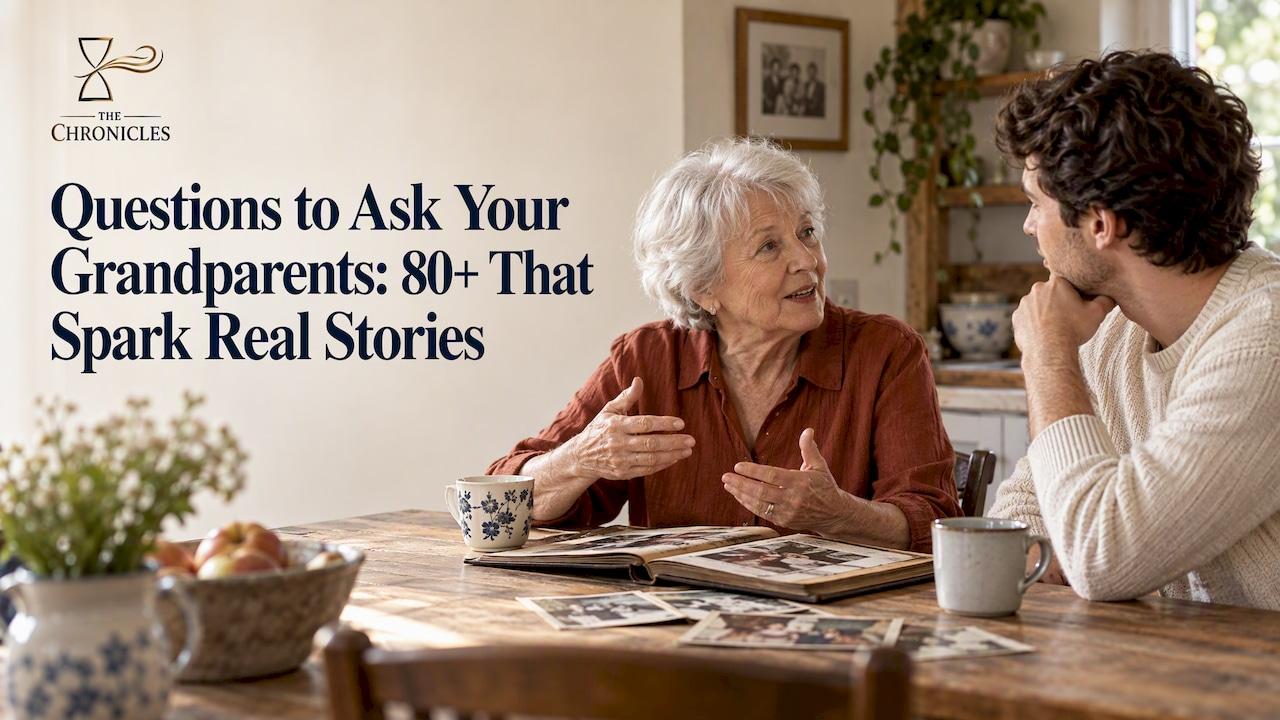
Questions to Ask Your Grandparents: 80+ That Spark Real Stories
The best questions to ask your grandparents are small and specific: what their kitchen smelled like, who they sat next to in school, what they were wearing the night they met your grandfather. Below you will find more than 80 of them, grouped by stage of life, along with a simple way to run the conversation and a plan for keeping the answers once you have them.
TL;DR
- Ask one open-ended question at a time, then wait. Silence is often where the real story starts.
- Start with childhood and names, which are easy to answer, and save the reflective questions for later in the conversation.
- Choose a quiet room, say who is speaking and when at the start of the recording, and explain what you plan to do with the stories.
- Follow their answers. A short list of questions is a map, not a script.
- Turn the answers into chapters while they are fresh, so the stories do not stay buried in a phone's voice memos.
Table of Contents
- Why a good question matters more than a long list
- Before you ask: set the table
- Questions about names, birthplace and early childhood
- Questions about parents, ancestors and family traditions
- Questions about the teenage years and young adulthood
- Questions about love, marriage and raising a family
- Questions about work and everyday life
- Questions about history and a changing world
- Deeper questions about wisdom, regrets and joy
- How to keep the conversation flowing
- What to do with the answers
- Our perspective
- Turn the answers into a family chronicle
- FAQ
- Sources
Why a good question matters more than a long list
Most of us have heard the same three stories from a grandparent for years. They are lovely, but they are only the top layer. A well-chosen question opens a door to the rest: the job they quit on a Friday, the town they left, the recipe that came from a neighbor and not from family.
The oral historians who train people to do this work agree on the basics. The National Park Service advises that you create a comfortable setting in a quiet place, build rapport through empathy and active listening, and ask one open-ended question at a time, being comfortable with silence so the person has time to reflect. That is good advice for a grandchild with a phone on the kitchen table, too.
A "yes or no" question gets a yes or a no. "What was the hardest winter you remember?" gets a chapter.
Before you ask: set the table
A little preparation makes the afternoon easier for both of you.
- Pick the place. Choose a quiet spot where you can face each other. The Smithsonian's oral history guide suggests turning off noisy equipment, closing doors, and arranging furniture so you can sit facing each other and still keep an eye on the recorder.
- Say what this is. The same guide recommends explaining the project and the storyteller's role and rights, and suggests a call or visit beforehand. Tell your grandparent you are collecting stories for the family, who will see them, and that they can skip any question.
- Start the recording with a simple introduction. The National Park Service recommends opening with the names of the interviewer and the narrator, the date, the location, and the project name. Years from now, that little spoken label will matter.
- Keep sessions short. Forty-five minutes to an hour is plenty. Several small visits beat one marathon.
- Bring a photo or an object. An old photograph, a watch, or a recipe card often unlocks more than any question.
The Smithsonian's folklife guide also notes that an interview works best when it follows the shape of a story, with a beginning, a middle and an end. That is why the questions below run roughly in order of a life, from earliest memories to what they would pass on.
Questions about names, birthplace and early childhood
These are the easy openers. They put your grandparent at ease and give you facts you will want for the family record. Folklife interviewers suggest starting with their name, their birthplace, and the story behind family names and naming traditions.
- What is your full name, and who chose it?
- Did you have a nickname? Who gave it to you?
- Is there a family name or tradition that gets passed down?
- When and where were you born? Did anyone ever tell you about that day?
- What was the house you grew up in like? Can you walk me through it room by room?
- What is your earliest memory?
- What did your bedroom look like? Did you share it?
- What smells or sounds take you straight back to being small?
- What games did you play, and who did you play them with?
- What was your favorite toy, and what happened to it?
- What did a normal Saturday look like?
- Who was your best friend as a child? Do you know what became of them?
- What chores did you have? Did you get an allowance?
- What did you eat for dinner, and who cooked?
- Were you ever in trouble? What for?
- What were you afraid of?
- What did your neighborhood look like, and who lived on your street?
- What was school like? Which teacher do you remember best?
Questions about parents, ancestors and family traditions
This is where family history lives. Your grandparent may be the last person who remembers certain names and places firsthand. Ask gently, and let them wander.
- What were your parents' names, and what were they like?
- Where did they grow up, and what did they do for work?
- What do you know about your grandparents, my great-great-grandparents?
- Where did our family come from before it came here?
- Did anyone in the family make a big move, and why?
- What stories were told at the dinner table again and again?
- Is there a famous (or infamous) relative we should know about?
- Which holidays did your family celebrate, and how?
- Were there religious or spiritual practices at home?
- Which recipes came down through the family? Who made them best?
- Did your family have reunions? What do you remember about them?
- Is there an heirloom you treasure? Where did it come from?
These themes echo what folklife researchers list as ways to uncover traditions and stories: holidays, religious practices, traditional recipes, reunions, heirlooms, and notable relatives. For ancestry specifically, the Tell Me Your Stories sample questions suggest asking where family members lived and worked, as well as their names.
Tip: when your grandparent names someone, ask, "How do you spell that?" It sounds small, but it saves hours of searching later.
Questions about the teenage years and young adulthood
This stretch of life is often the most vivid, and the one grandchildren know least about. Ideas drawn from the same professional question set include asking what kind of person they were, what school was like, what fashion and music were popular, who they admired, and what they did for fun.
- What kind of teenager were you?
- What music did you love? Did you ever go to a dance or a concert?
- What was the fashion, and what did you wear that you would be embarrassed about now?
- Who did you look up to?
- What was the biggest problem you faced as a teenager?
- What did you do for fun on a weekend?
- What did you do after high school?
- Did you leave home? What was that day like?
- What did you dream of becoming?
- When did you feel grown up for the first time?
- Who was a friend who shaped you?
- What was the best trip you took when you were young?
Questions about love, marriage and raising a family
These are tender, so go slowly and never push. If a grandparent has lost a spouse, offer the question and let them decide how far to take it. Many families find the most treasured recordings come from this part of the conversation.
- How did you meet your spouse? What did you think of them at first?
- Where did you go on your first date?
- How did the proposal happen?
- Tell me about your wedding day. What do you remember most?
- What was the first home you shared?
- What was it like becoming a parent?
- What did you learn from raising children that you did not expect?
- What was a funny thing my parent (or aunt, or uncle) did as a child?
- What traditions did you start in your own family?
- What makes a marriage last, in your experience?
- What was the hardest year of your marriage, and how did you get through it?
- What do you hope your grandchildren understand about love?
Be ready for tears. They are not a sign you asked the wrong thing. Sit quietly, and let your grandparent decide when to continue.
Questions about work and everyday life
A career often tells you more about a person's character than any adjective could. Ask about their first job and the turns their work life took, as in the sample interview questions on work and life events.
- What was your first job, and what did it pay?
- How did you get it?
- What did you learn from your first boss?
- Did you ever change careers? What made you decide?
- What was a typical day at work?
- What are you proudest of professionally?
- Was there a time you almost quit?
- What did you do with your first paycheck?
- How did you save money, and what did you splurge on?
- What skills do you have that nobody asks about?
Questions about history and a changing world
Your grandparent has lived through events you read about in textbooks. Ask what it felt like at ground level, in their own town, rather than asking for a summary of the news.
- Which historical event affected your life most, and how did your life change because of it?
- Where were you when you heard the big news of your generation?
- What did the first television, telephone, or computer in your home look like?
- How did people stay in touch before cell phones?
- What did things cost when you were young? A loaf of bread, a movie ticket, a car?
- What changed most in your town over the years?
- What do you miss about the old days? What are you glad is gone?
- What worried people then that seems strange now?
Deeper questions about wisdom, regrets and joy
Save these for the end, when trust has built. They tend to produce the answers families quote at funerals and weddings.
- What are you proudest of in your life?
- What would you do differently?
- What was the best decision you ever made?
- Who were the most important people in your life, and why?
- When have you felt most at peace?
- What do you want your great-grandchildren to know about you?
- What advice would you give me right now?
- What is a small joy you never get tired of?
- How would you like to be remembered?
How to keep the conversation flowing
A list only works if you are listening. A few habits help.
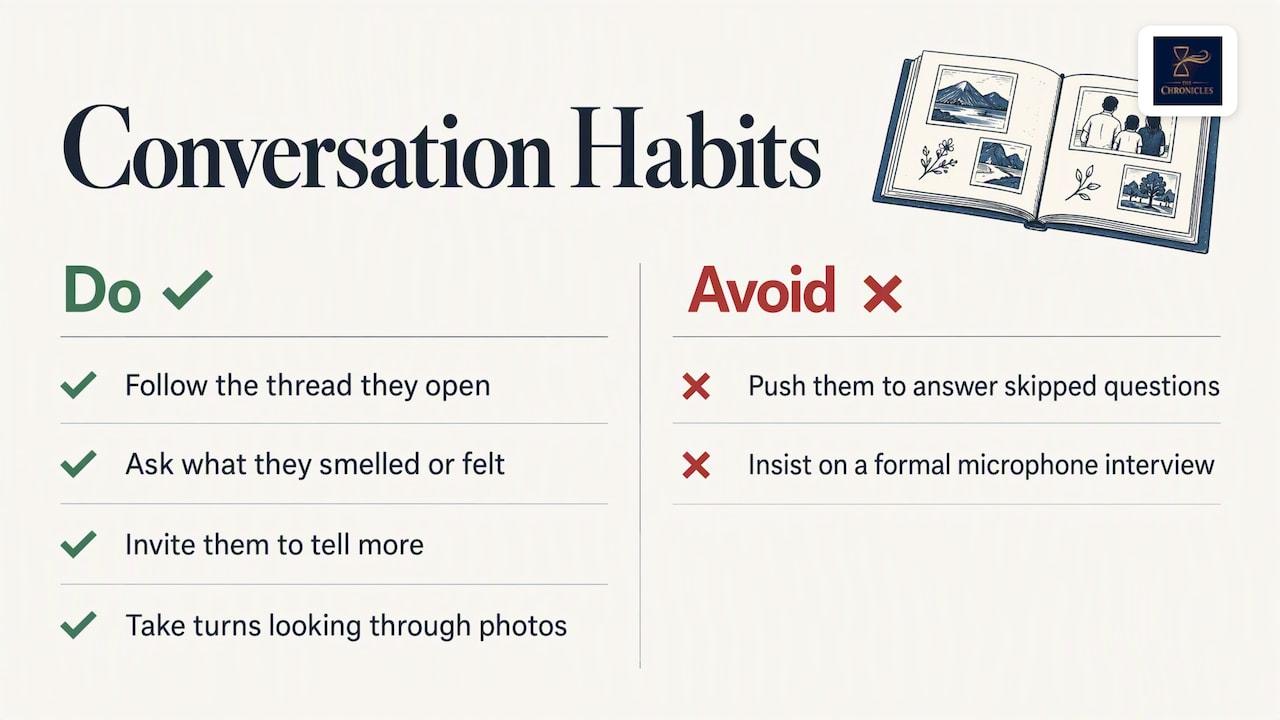
Follow the thread. If your grandmother mentions a train ride, drop your next question and ask about the train. The interview guide you prepared is a scaffold, as oral history researchers at the Southern Oral History Program describe it: it keeps you on track while leaving room for discovery.
Ask for the senses. "What did it smell like?" and "What was the weather?" pull out scenes, not summaries.
Try "Tell me more." It is the most useful follow-up there is.
Let them say no. A skipped question is still a good interview.
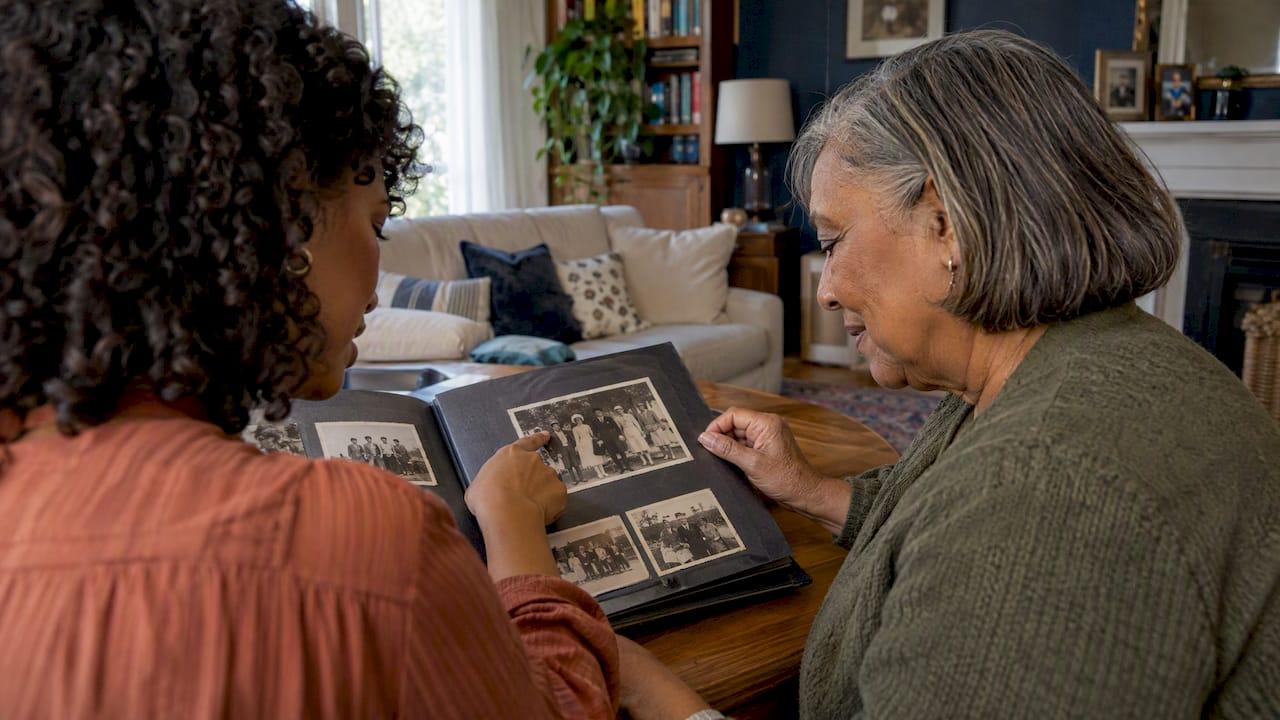
Take turns with photos. Looking through an album together can replace a formal interview entirely, which suits many grandparents who dislike microphones.
What to do with the answers
Recording is the easy part. The harder part is keeping the stories findable, readable, and shared. A folder of 40-minute audio files rarely gets opened again.
A few practical steps:
- Label right away. Add the name, date and topic to each recording.
- Back it up in two places. A phone is not an archive.
- Write down the key facts (names, places, dates) while you remember the context.
- Turn answers into short chapters. One memory per page is easier to read than a transcript.
- Share with relatives. Aunts and cousins will add details you missed.
If you want the stories to end up in a museum or local archive, the guidance from one oral history training program is to discuss any usage restrictions with the storyteller and contact the institution to set those terms before you hand anything over. For a family keepsake, simply agree who may see what.
For more on methods, see our guide to the best ways to record a grandparent's life story and our essay on preserving family stories before they are gone.
Our perspective
We built The Chronicles because we kept seeing the same thing: families who meant to ask, who even wrote the questions down, and then ran out of weekends.
Our view is that the question is only half the gift. The other half is where the answer goes. A story that lives in a shoebox of recordings is a story only one person can reach. A story that becomes a chapter, with a photo beside it and a voice you can hear, becomes something a family can hold, add to and hand down.
That is why we designed the platform around the way families really are. Not everyone is comfortable with technology, so relatives can answer guided questions by email, with no login. Photos and short notes can become written chapters. Real voice narration can let a grandchild hear the story as it was told. And we pledge that your family's data is not used to train AI, and the stories remain yours.
Start with one question this week. Then give the answer a home.
Kevin
Turn the answers into a family chronicle
Once you have a few good answers, The Chronicles can help you shape them into chapters. You can begin on the Free plan at $0. The Chronicle plan is $7 per month, and the Family plan is $15 per month, so several relatives can add to the same story. If you want something to hold, printed books start at $49 for a paperback and $99 for a hardback, ordered separately.
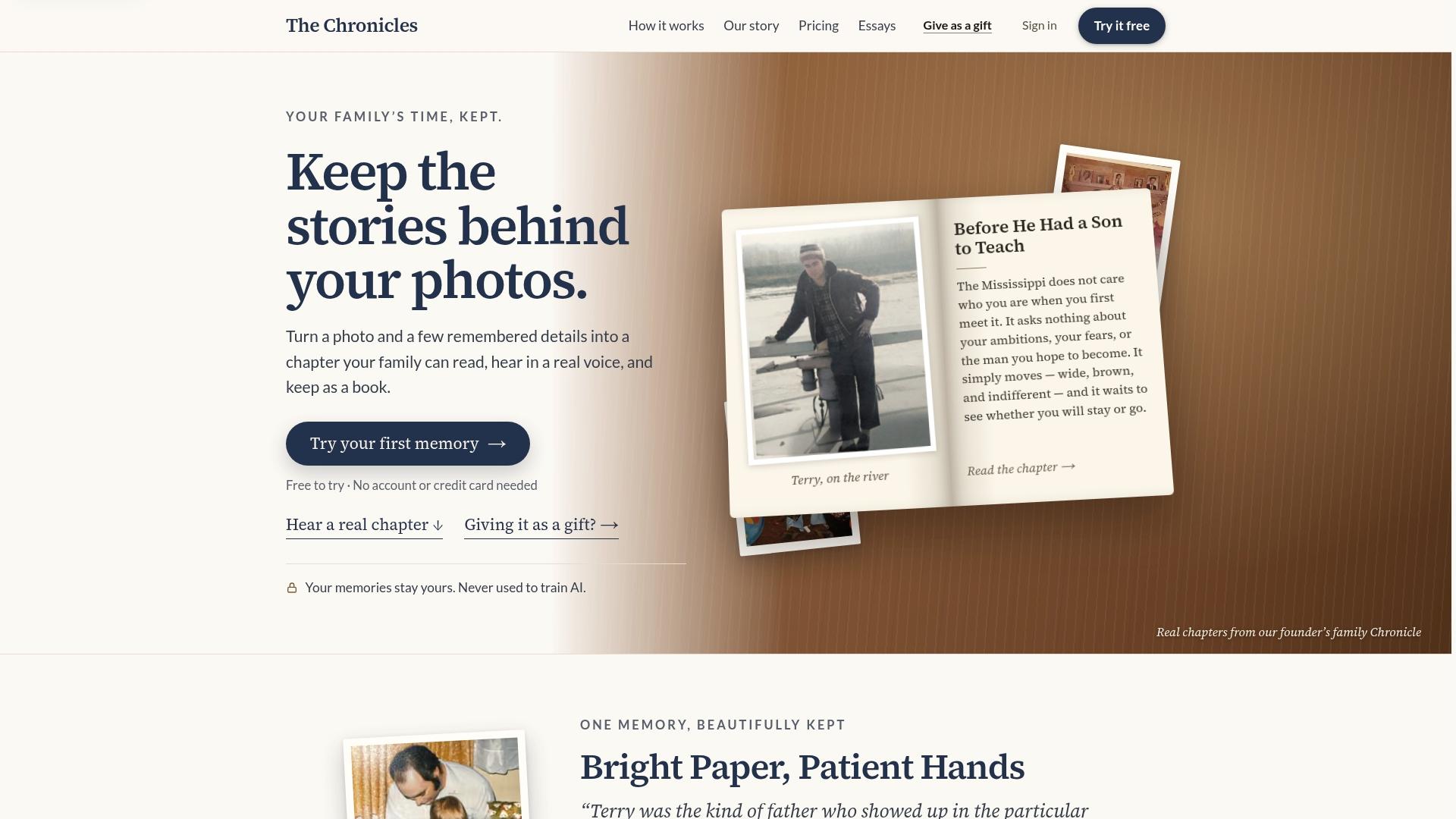
You can start your family chronicle here, or see how photos become chapters with the AI memoir writer. If your grandparent would rather talk than type, a voice memory book lets their stories be heard aloud. And if you are gathering stories for a grandparent specifically, our grandparent memory book page shows how it works. When you are ready for a keepsake on the shelf, take a look at paperback and hardback books.
If you are gathering memories after a loss, we have a gentler guide: how to make a memory book after someone dies.
FAQ
How many questions should I ask in one sitting?
Fewer than you think. Five to ten questions, with room for follow-ups, usually fill an hour. It is better to have three short, relaxed visits than one tiring afternoon.
What if my grandparent says they have nothing interesting to share?
This is common, and it is almost never true. Start with concrete things such as the house they grew up in, their first job or a favorite meal. Bring an old photo, because pictures help people remember details they would not think to mention.
What if a question upsets my grandparent?
Stop, pause the recording if you like, and let them lead. Offer to move on or come back another day. Some memories are painful, and a good interviewer makes it clear that skipping a question is always fine.
Can I ask questions if my grandparent lives far away?
Yes. You can do it over a video call, or send a few questions at a time by email so they can answer at their own pace. The Chronicles supports guided email interviews, so relatives can reply without creating an account.
Should I write the questions down beforehand?
Yes, a short list helps. Choose ten or so, put the easy ones first, and treat the list as a guide. If the conversation goes somewhere better, follow it.
Sources
- Interviewing, U.S. National Park Service
- How to Do Oral History, Smithsonian Institution Archives
- The Interview, Smithsonian Folklife and Oral History Interviewing Guide
- Some Possible Questions, Smithsonian Center for Folklife
- Tell Me Your Stories sample interview questions
- A Practical Guide to Oral History, Southern Oral History Program
- Recording stories and conducting an interview, Grandma's Story
Recommended
From the founder
Start your first chapter — three minutes, no account.
Drop in a photograph of someone you love. Write three sentences about a moment with them. The Chronicles writes the chapter.
Try it free →Questions or thoughts? kevin@thechronicles.life — I read everything.